Since 2 August 2026 a particular claim has been circulating: that everything touched by AI now has to carry a label. Product descriptions, social captions, blog posts, the abstract image at the top of a newsletter.
That is not what the rules say, and the gap between the claim and the rule is large enough to be worth twenty minutes of your time.
General information, not legal advice. Where a decision turns on the detail, take advice on your own situation.
Applies to you if
- You publish AI-generated or manipulated video, audio or realistic imagery that appears to show a real person, place or event.
- You publish AI-generated text to inform the public on a matter of public interest, and nobody reviewed it.
- You run a chatbot or voice agent that customers might reasonably mistake for a person.
- You use emotion recognition or biometric categorisation on staff or customers.
Probably does not apply if
- You draft marketing copy, product descriptions or emails with AI and a person edits and approves them.
- You use an abstract or clearly illustrative generated image that nobody would take for a photograph.
- You use AI to summarise, transcribe, translate or tidy internal documents.
- Your chatbot is plainly a chatbot, sitting in a widget that says so.
What Article 50 actually contains
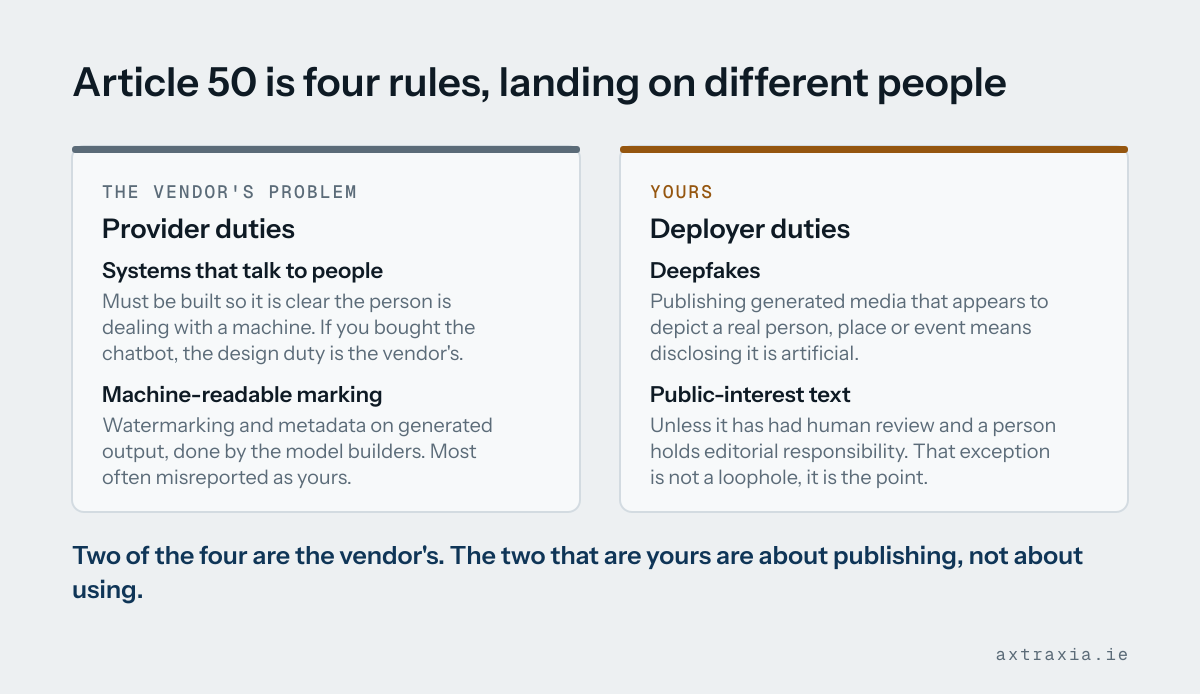
The confusion comes from treating it as one rule. It is four, landing on different people.
1. Systems that talk to people
A provider duty. Systems designed to interact directly with people must be built so it is clear the person is dealing with a machine, unless that is obvious from the circumstances.
If you bought your chatbot from a vendor, the design duty is theirs. Yours is the practical one: do not configure it to pass itself off as a named human colleague.
2. Machine-readable marking
Also a provider duty, and the one most often misreported as yours. Providers of systems generating synthetic text, image, audio or video must mark the output so machines can detect it was generated.
This is watermarking and metadata, not a visible caption. It is done by OpenAI, Microsoft, Adobe and the rest, in their systems. There is a transitional deadline of 2 December 2026 for generative systems already on the market before August.
3. Deepfakes
A deployer duty, and this one is yours. If you publish generated or manipulated image, audio or video content that appears to depict a real person, place or event, you must disclose that it is artificial.
The test is realism and reference to something real, not whether AI was involved. A stylised illustration of a workshop is not a deepfake. A photorealistic image of your actual premises that was generated rather than photographed is much closer to one. Artistic, satirical and fictional work gets a more proportionate form of disclosure that does not spoil the work.
4. Public-interest text
A deployer duty with the exception that matters most to anyone publishing a blog. If you publish AI-generated or manipulated text to inform the public on matters of public interest, you must disclose it.
Unless the content has undergone human review or editorial control and a natural or legal person holds editorial responsibility for the publication.
That exception is not a loophole, it is the point. The concern is unreviewed machine output presented as informed comment. A person who checks the claims, edits the text and puts their name to it has taken responsibility, which is the thing the rule is asking for.
Three situations, worked through
A joinery firm generating product descriptions. Two hundred descriptions drafted by AI, edited by the office manager, published on the shop. No disclosure duty. Not public-interest text, not a deepfake, and reviewed by a person in any case.
A dental practice with an out-of-hours chatbot. The widget says it is an automated assistant and offers a number for anything urgent. Duty satisfied, and the design duty sat with the vendor anyway. It would be a problem if it introduced itself as “Sarah on reception”.
An estate agent generating property imagery. Photorealistic images of a house that does not look like that, presented among real photographs, is exactly what the deepfake rule is about. Consumer protection law was already unimpressed by this. The AI Act adds a disclosure duty on top.
Legal duty, and good practice
Worth keeping these apart, because a lot of advice blurs them.
Legally required: deepfake disclosure, unreviewed public-interest text disclosure, telling people they are talking to a machine, and telling people exposed to emotion recognition or biometric categorisation.
Good practice, not required: a note saying AI assisted with research or a first draft, on work you reviewed and stand over. It builds trust precisely because it is voluntary, and because it is paired with someone’s name.
Actively unhelpful: stamping “AI generated” on everything. It tells a reader nothing about whether anyone checked it, which is the thing they actually want to know, and it devalues the disclosure where it genuinely matters.
Five things worth doing
- List where you publish generated media, particularly anything photorealistic or referring to a real place, person or event.
- Check your chatbot introduces itself honestly and offers a route to a human.
- Decide who holds editorial responsibility for anything you publish, and make sure that person actually reads it before it goes out.
- Keep a light record of what was drafted with AI and who approved it. Not a statutory requirement, but it is the evidence that the review happened.
- Stop worrying about ordinary copy. Edited marketing text needs no label, and behaving as though it does is a cost with no benefit.
Common misconceptions
- “Everything made with AI must be labelled.” No. Four specific duties, most of them on providers.
- “We have to watermark our images.” Machine-readable marking is a duty on whoever built the generator, not on you for using it.
- “Any AI-written blog post needs a disclaimer.” Only unreviewed public-interest text. Human review with someone taking editorial responsibility is an express exception.
- “This is about AI, so GDPR does not come into it.” Different regimes. If personal data is involved, GDPR applies separately and asks different questions.
The honest summary
If you edit what AI drafts and put a name to it, the labelling rules mostly are not about you. If you publish realistic generated media of real things, they very much are.
The rest of the Act is covered in the plain-English overview. If you are unsure whether something you publish falls the wrong side of the deepfake line, describe what it is and you will get a straight answer.
Sources
Article 50 of Regulation (EU) 2024/1689 as amended by Regulation (EU) 2026/1744, on EUR-Lex, and the European Commission’s Article 50 transparency guidance published in July 2026. Checked 6 August 2026.
Common questions
Do I need to label AI-written product descriptions?
No. Product descriptions are not text informing the public on a matter of public interest, and in any case a person editing and approving them engages the human editorial responsibility exception.
What counts as a deepfake?
Generated or manipulated image, audio or video that appears to depict a real person, place or event. The test is realism and reference to something real, not whether AI was used. A stylised illustration is not one.
Does a blog post drafted with AI need a disclaimer?
Only if it is public-interest text published without human review. Where a person has checked the claims, edited it and holds editorial responsibility, the Act expressly excepts it. A voluntary note is good practice, not a duty.
Whose job is watermarking?
The provider’s. Companies building generative systems must mark outputs in a machine-readable way, with a transitional deadline of 2 December 2026 for systems already on the market. It is not something you apply yourself.