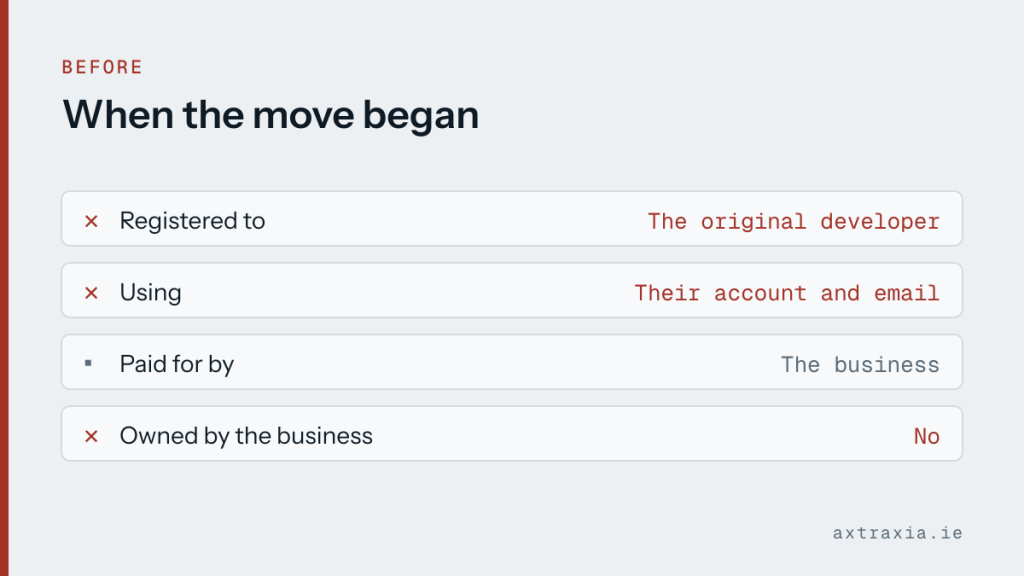

A business wanted to move its website to a new host. Straightforward work, until nobody could produce the login for the domain.
It was registered to the developer who had built the original site, six years earlier, using their own account and their own email address. The business had paid for it and had never owned it.
Why this is so common
It is almost never anything sinister. A developer sets everything up at the start because it is faster than walking a client through account creation, fully intending to transfer it later, and later never arrives because nothing ever forces the issue.
The arrangement then works perfectly for years. It only surfaces at the exact moment you need to change something, which is also the moment you have the least patience for it.
The fix, and the better fix
The original developer was contactable and helpful, and the transfer took a fortnight of back and forth. That is the good outcome. The bad outcomes are a developer who has moved on, closed the business, or is simply unreachable, and a domain that renews automatically until one day it does not.
The better fix is a policy rather than a repair: the business holds the registrar account, in a business email address, with billing on a company card. Suppliers get access to it. They do not own it.
Worth doing today
Try to log in to your domain registrar. Not “find the password somewhere”, actually log in. If you cannot, you have found something worth resolving while everyone is still on good terms.
Do the same for hosting, your analytics, your business profile listing and any account holding customer data. Check the recovery email on each one is not a former employee’s.
This belongs at the top of the things to agree before anyone starts work, and it is the single most common way a small business ends up stuck. If you are not sure what you own, describe what you have access to and it is usually clear quickly.